
The price of an acre in Florida depends on land type, county and use, so the first job is matching the right number to your plan. Every site quotes a different per-acre figure, which makes a budget hard to set. If you are building a custom home, the acre is the first line of your budget, not the whole budget.
Current figures come from 2026 releases, because USDA 2027 land values will not exist until summer 2027. Start with the number that matches your land, compare counties and the features that drive price, then add the site work that comes before what the build itself costs, and run the pre-offer checks before you time a purchase.
Ready to price the land and the build together? Talk to Seanote Construction about your parcel before you make an offer.
Key Takeaways
- Match the figure to your land: USDA NASS puts Florida farm real estate at $9,150 per acre, while the Department of Revenue residential vacant land median is near $74,000 per acre.
- County sets the range: Department of Revenue medians run from about $7,700 per acre in Holmes to over $3.18 million in Miami-Dade, with Gilchrist near $18,000 and Marion near $53,000.
- Budget for a buildable acre: site work on a rural parcel can add $30,000 to $80,000 or more, so compare total cost, not price per acre.
Average Price Of A Florida Acre
The average price of an acre in Florida is not one number. Farm real estate, residential vacant land and listing ranges each measure different land, so each gives a different figure.
The USDA NASS July 2026 release puts Florida farm real estate at $9,150 per acre, cropland at $11,100 and pasture at $7,650. Those figures fit a cattle or timber buyer.
Florida Department of Revenue data puts the 2026 residential vacant land median near $74,000 per acre, which is closer to what a homesite buyer pays. Listing ranges show asking prices, not sales.
| Figure | What it measures | Main limit | Best fit |
|---|---|---|---|
| USDA NASS farm real estate | Farm and ranch land sales | Not residential or commercial | Cattle or timber buyer |
| DOR residential vacant median | Vacant homesite land by county | Median hides parcel differences | Homesite buyer |
| Listing and marketing ranges | Asking prices and estimates | Unofficial, not sold prices | Early research only |
Figure 1: Pick the figure that matches your land type, not the biggest or smallest number you see. Source: USDA NASS Land Values Summary, July 2026; Florida Department of Revenue.
The USDA Economic Research Service reports that U.S. farmland averaged $4,500 per acre in 2026, up 3.4 percent from 2025, or 0.4 percent after inflation. The same source puts the Southeast region at $6,000 per acre, with cropland at $6,080 and pasture at $5,920.
Neither is a Florida homesite price. You can compare these with last year’s acre price update.
Which Florida Counties Have The Cheapest Acres?
The cheapest acres in Florida sit in rural counties such as Holmes, Gilchrist, Suwannee and Levy. Miami-Dade sits far above every other county. Florida Department of Revenue medians run from about $7,700 per acre in Holmes to over $3.18 million in Miami-Dade.
Treat these medians as planning guides, not offers. A low price per acre usually means a longer drive to jobs, thinner utilities and fewer buyers when you sell.
North Central Florida Acre Prices
Gilchrist is the cheapest of the three main North Central counties, Marion sits mid-range, and Alachua near-city land can pass six figures. Department of Revenue medians put Gilchrist near $18,000 per acre and Marion near $53,000, with Suwannee and Levy toward the low end. Commute time, utility reach and growth pressure drive the gaps.
Alachua County holds several markets at once. Rural farmland trades far below a homesite near the University of Florida, where short drives and city water push the price per acre into six figures.
How To Pull Real Sold Prices
Search the county property appraiser’s sales records for qualified vacant-land sales, then divide each sale price by usable acres. A qualified sale is one the appraiser treats as a fair, open-market trade.
- Search: open the appraiser’s sales search.
- Narrow: keep the last 12 to 24 months, vacant land use codes and acreage close to yours.
- Divide: sale price by usable acres.
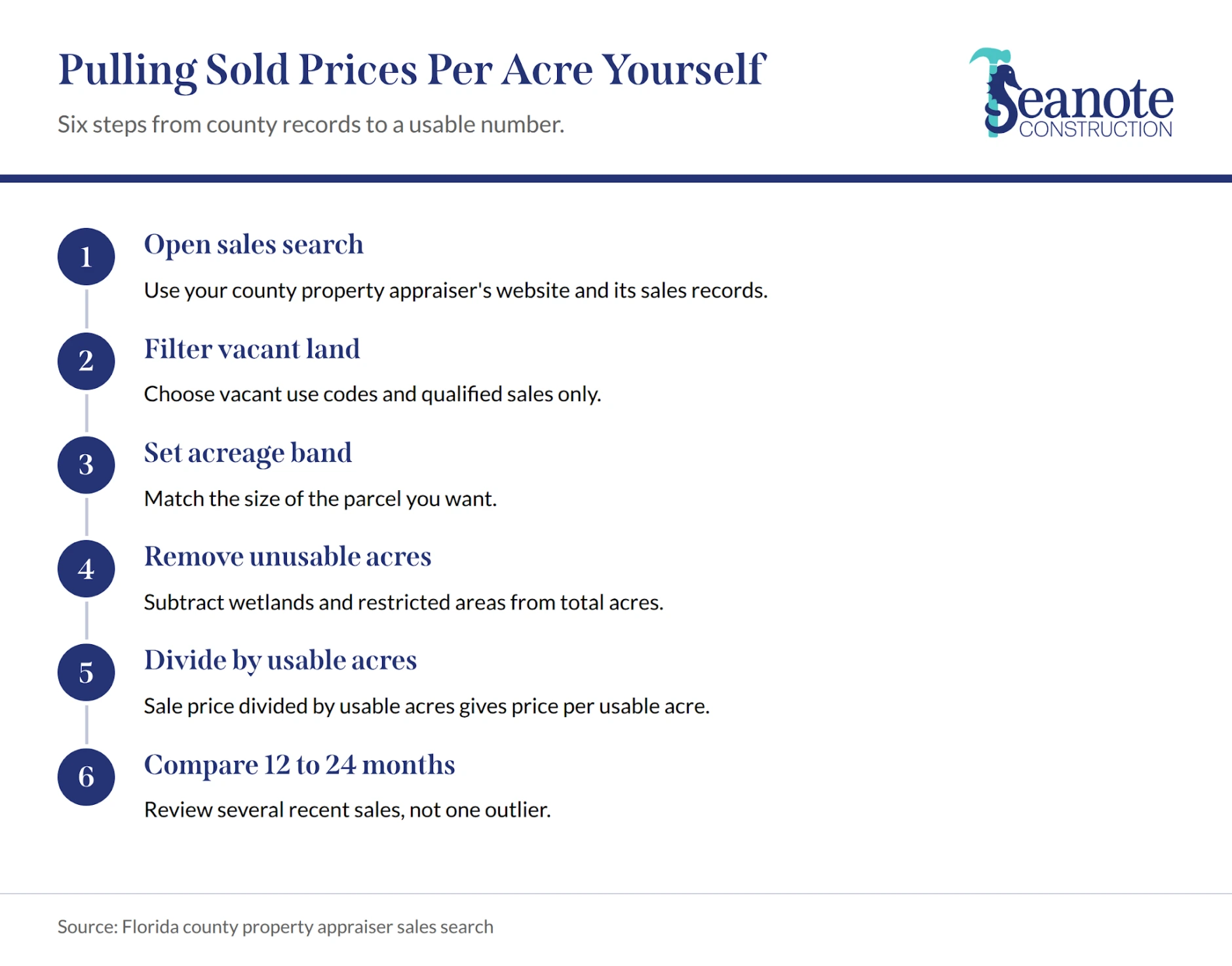
Figure 2: Divide each sale by usable acres, not total acres, to compare fairly. Source: Florida county property appraiser sales search.
Price per usable acre is the sale price divided by the acres left after removing wetlands and restricted areas. As an illustration, not market data, picture a 10-acre parcel that sells for $150,000 with 2 acres of wetland.
That works out to $15,000 per gross acre but $18,750 per usable acre. The appraiser’s just value, the tax-roll estimate, is not a market price.
What Makes One Florida Acre Cost More?
One Florida acre costs more than another when it is easier to build on and closer to growth. Six land features move price, each through cost or risk.
Land Features That Move Price
- Zoning: residential zoning raises price because it allows your home.
- Flood zone: lowers price because of elevation rules and insurance.
- Wetlands: lower price because they shrink usable acres.
- Access and utilities: raise price because they cut site costs.
- Soil: poor septic soil lowers price because it forces a costlier system.
- Distance to growth: nearness to jobs raises price because more buyers compete.
Parcel Size And Price Per Acre
Parcel size and price per acre move in opposite directions. A quarter-acre lot is priced per lot, as one homesite, and 20 acres usually sells at a lower per-acre price than 1 acre.
Straight math for 1/4, 1, 5, 7 and 20 acres:
- USDA NASS Florida farm real estate at $9,150: $2,288, $9,150, $45,750, $64,050, $183,000.
- Department of Revenue Gilchrist median, about $18,000: $4,500, $18,000, $90,000, $126,000, $360,000.
- Department of Revenue Marion median, about $53,000: $13,250, $53,000, $265,000, $371,000, $1,060,000.
- Alachua near-city land, illustrated at $100,000: $25,000, $100,000, $500,000, $700,000, $2,000,000.
Multiplying an average by acres misleads for a real parcel. The USDA figure blends farms, and the county-median rows overstate most 20-acre sales.
What Does A Buildable Acre Really Cost?
A buildable acre costs the land price plus site work: clearing, driveway, septic and well, power, impact fees and survey. On rural parcels, site work can match or pass the purchase price.
Raw land has no road, utilities or approvals. Improved land has access and some utilities at the line.
A buildable acre is ready for a permit. The National Association of Home Builders rule of thumb puts land at 10 to 25 percent of the total build budget.
Site Costs Added To Land Price
Site costs on a 1-acre rural parcel in Marion or Gilchrist County depend on distance to roads and lines. This illustration uses a Marion homesite:
- Land: about $53,000, the Department of Revenue median.
- Septic and well: $15,000 to $30,000 in common Florida planning ranges. A septic system treats household wastewater in a tank and drain field on your land.
- Power extension: $15,000 to $50,000, set by distance to the nearest line.
- Clearing, driveway, impact fees and survey: priced after a site walk. Impact fees are one-time county charges paid at permitting.
Our planning range for these site costs runs $30,000 to $80,000 or more. That puts this buildable acre near $83,000 to $133,000 or more before the house.
A $53,000 acre fits the 10 to 25 percent rule on total budgets of about $212,000 to $530,000. A construction cost estimate shows where your own numbers fall.
Cheap Acre Versus Pricier Lot
A cheap acre can cost more to build on than a pricier lot when it needs a long power run, fill dirt or a costly septic design. As an illustration, a remote $18,000 Gilchrist acre with $50,000 of power and a $30,000 engineered septic and well totals $98,000. A $53,000 Marion acre with $15,000 of power and a $15,000 septic and well totals $83,000.
The $18,000 acre ends up $15,000 higher. Compare total cost to a finished homesite, not price per acre.
What Should You Check Before Buying Florida Land?
Run seven checks before buying Florida land, ordered by what ends a deal fastest. A failed check either stops the plan or adds cost.
- Zoning: county planning department. Failure means no home or a rezoning.
- Flood zone: FEMA flood maps. Base flood elevation is the expected flood height, and a high-risk zone raises floor height and insurance costs.
- Wetlands: the water management district. Expect lost acres and permit time.
- Septic soil: Florida Department of Health onsite sewage program. A failed percolation test, a soil drainage test, forces a costlier system.
- Legal access: a title search. No recorded access can block a permit.
- Utilities: an availability letter from the utility. Distance adds extension cost.
- Impact fees: county permitting office. They add a one-time charge.
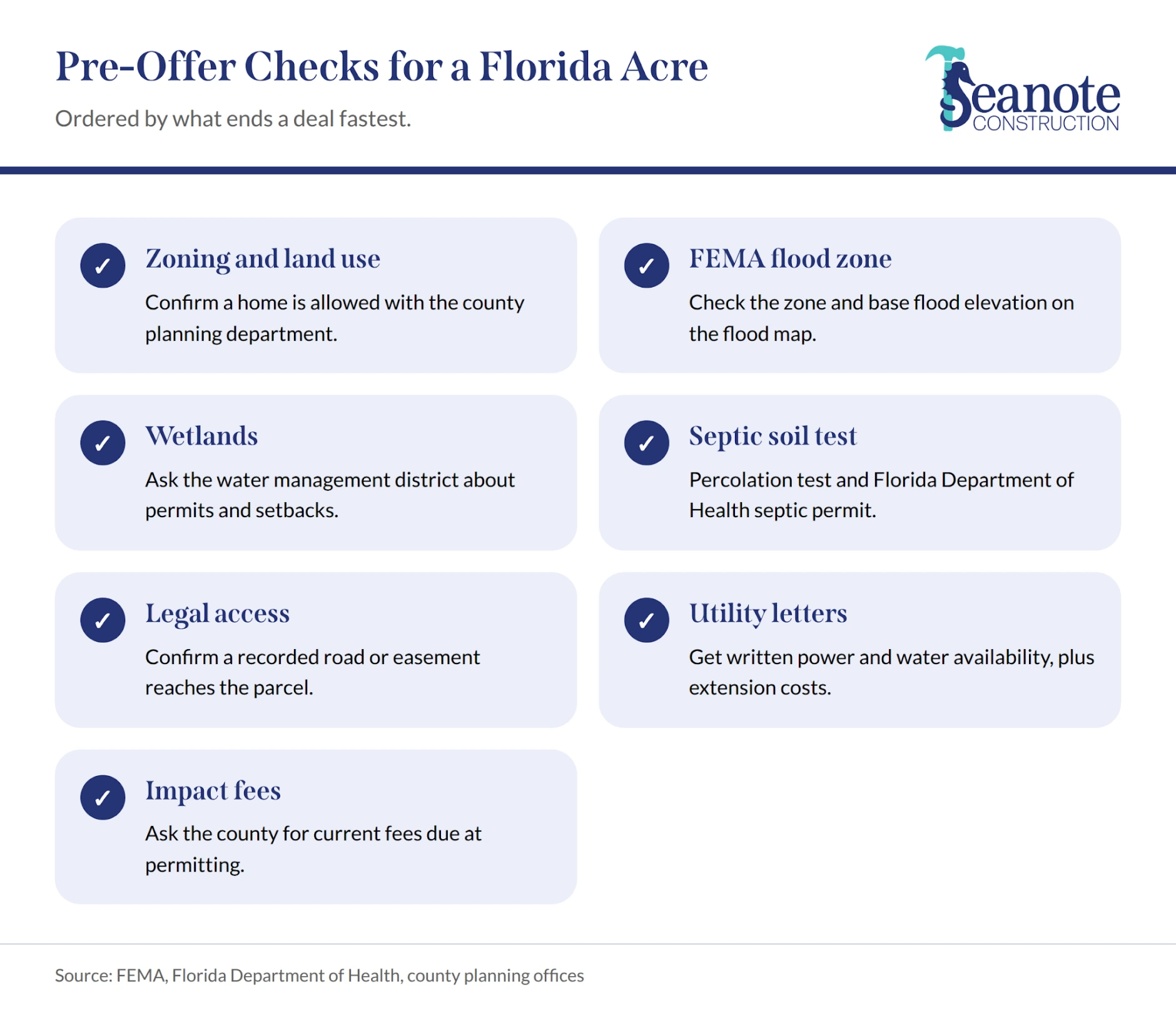
Figure 3: A failed check changes your budget, so run them before you make an offer. Source: FEMA, Florida Department of Health, county planning offices.
Permit review time depends on the county’s queue. Knowing when a permit applies helps you set the order of work.
Can You Buy A Florida Acre For $1,000?
No, you cannot buy a usable, legally accessible Florida acre for $1,000. Even Holmes County’s residential vacant median sits near $7,700 per acre, according to Department of Revenue data.
Sub-$5,000 listings carry red flags: no legal access, wetlands, a flood zone, unrecorded roads, old platted subdivisions with no utilities, or tax-deed and scam listings. Before paying, confirm recorded access, pull the parcel record, check the flood map and call the planning office. Never wire money for land you have not seen.
Is Now A Good Time For Florida Land?
Yes, if you need to build within a set window and the parcel passes the checks. No 2027 figures exist yet, so we make no forecast.
USDA NASS data shows Florida farm real estate rose 13.4 percent in 2024 and 5.2 percent in 2026. Department of Revenue data shows statewide vacant land down 0.35 percent from 2024 to 2025. The USDA Economic Research Service reports that inflation-adjusted Southeast farm real estate rose 1.3 percent from 2025 to 2026, the top of the regional range, while the Delta States fell 0.7 percent.
According to Florida Realtors data reported by The Florida Press, the single-family median was $420,000 in Q1 2026, up 1.8 percent. Active listings stood near 165,000. Buy for a build timeline, not a price hunch, and line up financing options early.
Frequently Asked Questions
What Is The 3-3-3 Rule?
The 3-3-3 rule in real estate is not a standard land-pricing rule. Versions circulate as budgeting or showing-schedule guides, and none is a legal or market standard. Rely on sold prices and the pre-offer checks instead.
Nicest, Cheapest Place To Live?
For most buyers, the nicest low-cost places in Florida are smaller North Central and Big Bend towns. They cost less than coastal metros but mean longer drives to jobs and services. Weigh land price, insurance, flood zone and commute together.
Why Are Florida Houses Not Selling?
Houses are selling slower in Florida because higher financing and insurance costs meet a larger supply of listings. Florida Realtors Q1 2026 figures show that supply. Land buyers feel the same financing pressure.
Plan The Land And Build Together
Buying land before you know the full cost is a hard spot, and checking first is the calmer path. We walk the parcel with you, run the pre-offer checks and lay out a line-by-line budget before you start buying land to build on.
Seanote Construction holds Florida Certified Building Contractor license CBC1264297, and Kayla and Kyle are your contacts from the first conversation on. We serve Gainesville and North Central Florida, including Alachua County, Ocala and The Villages. Bring a parcel address, and let’s talk through your project with no pressure.