
The cost to build a house in Florida is the construction cost per square foot plus land, site work, utilities, permits, impact fees and contingency. That’s why per-foot figures for the same house can run from $150 to $250. A budget built on a bare per-foot number feels shaky, and that unease is reasonable.
We work as a custom home builder on inland Gainesville and North Central Florida lots, which price differently from the coasts. Below you’ll find a worked budget, a $300,000 test, Florida’s cost rules with prices attached, and a formula you can check.
Hard costs are the materials and labor in the house. Soft costs are the design, permits, fees, interest and insurance around it. At Seanote Construction, we will help manage your project from start to finish.
Key Takeaways
- Per-foot quotes don’t show the full cost. In the worked 2,000 sq ft example, hard costs come to $151 per foot, but the all-in total with site work, septic, permits and impact fees, builder fee and contingency is about $206 per foot, or $412,500.
- Plan for higher prices in 2027. We project roughly $180 to $185 per square foot for a custom home before the lot, a new Florida Building Code edition takes effect December 31, 2026, and impact fees range from about $9,800 in Brevard to $47,700 in Osceola.
- Your contract and Florida law protect your budget. Write allowances, a capped escalation clause and the change-order process into the contract, verify the builder’s license, and collect lien releases with each draw tied to a passed inspection.
What Is Florida’s Build Cost Per Square Foot?
Florida’s build cost per square foot is the construction price divided by heated living area. For 2027, plan on roughly $180 to $185 per square foot for a custom home, lot excluded. That’s our projection, because Census figures for homes started in 2026 and 2027 aren’t published yet.
According to the National Association of Home Builders’ 2026 analysis of Census data, the median custom home started in 2025 cost $171 per square foot, and homes built to sell ran $152, both excluding the lot. In the South Atlantic region, which includes Florida, custom homes ran about 7% above homes built to sell. For a 2,000-square-foot custom home, $171 works out to about $342,000 before the lot.
Costs are more likely to rise than fall in 2027. NAHB reports that building material prices in September 2026 were up 5.5% from a year earlier, the fastest pace since 2022. Total inputs to residential construction, including energy, were up 10.3%. We project a 5% to 8% increase over 2025 levels, which puts a 2,000-square-foot custom home at about $360,000 to $370,000 before the lot.
How Is Cost Per Foot Calculated?
Cost per foot is a stated cost total divided by heated square feet. The result changes with what that total includes, so always write down the top number.
All-in cost per foot = (hard cost + site work + utilities + permits and fees + builder fee + contingency) ÷ heated sq ft
Fill in each input from your own bid. Heated area leaves out the garage and porch, which cost less per foot to build.
Which Costs Do Per-Foot Quotes Omit?
Per-foot quotes usually omit six costs: the lot, site work, utility or septic connections, impact fees, financing and contingency. The National Association of Home Builders’ survey puts construction at 64.4% of a builder’s sales price.
The same survey puts the finished lot at 13.7% and builder profit at 11.0%. The rest is overhead, commissions, financing and marketing. Raw land is a separate purchase, so check what land costs per acre before you set a total.
What Does A 2,000 Sq Ft House Cost?
A 2,000 sq ft house costs about $302,000 in hard costs and about $412,500 all-in in the worked example below. Those two figures, $151 and $206 per foot, show how $150 and $250 quotes can describe the same house.
The house is single story, block and stucco, on a slab, in Alachua County, on a lot already owned. The six hard-cost lines sit inside the NAHB range above. Every line marked as an assumption is illustrative, so replace it with your own number.
Eleven budget lines:
- Site prep and clearing: $12,000
- Foundation, slab: $28,000
- Shell, block walls and roof framing: $72,000
- Roof: $24,000
- Windows and exterior doors: $22,000
- MEP, meaning mechanical, electrical and plumbing: $60,000
- Finishes, from drywall to cabinets and flooring: $96,000
- Septic system or utility tie-in: $15,000
- Permits and impact fees: $10,000
- Builder fee: $36,000
- Contingency at 10%: $37,500
Hard cost alone is $302,000, or $151 per foot. All-in is $412,500, or about $206 per foot. That’s a $55 per foot gap on one house.
Contingency gets spent in four places: soil surprises, allowance upgrades, change orders and material swaps. A change order is a written change to the plan and price after signing.
Estimate Your Own Build
Our 2027 calculator uses the same line-by-line method for your county, size and finish level. Every result is a low to high range, so you can see where your budget might land before you talk to a builder.
Is $300,000 Enough To Build A House?
Yes, $300,000 is enough for a smaller builder-grade house on an owned lot with utilities nearby. It usually isn’t enough for a 2,000 sq ft mid-grade or custom house in North Central Florida once site work, fees and contingency come off.
The subtraction, with each input as an assumption:
- Starting budget: $300,000
- Site work: minus $12,000
- Septic and well: minus $15,000
- Permits and impact fees: minus $10,000
- 10% contingency: minus $30,000
- Hard-cost budget left: $233,000
Three finish tiers, using illustrative per-foot rates that include the builder fee:
- Builder-grade at $135 per foot: about 1,725 sq ft
- Mid-grade at $165 per foot: about 1,410 sq ft
- Custom at $210 per foot: about 1,110 sq ft
Builder-grade fits a modest home. Mid-grade and custom fit only well under 2,000 sq ft. For scale, the National Association of Home Builders reports the median new U.S. single-family home was 2,194 square feet in 2025.
When numbers run close, we trim size first, then roof complexity, then plumbing runs, then finish allowances. A simple roofline and back-to-back bathrooms save money without changing how the house lives.
Which Florida Rules Raise Build Cost?
Six Florida rules raise build cost: wind design, flood elevation, soil, septic, energy and impact fees. Each traces to a code, an agency or a county schedule. A permit inspection is a county check that work meets code before the next stage begins.
How Do Building Codes Add Cost?
Building codes add cost through six requirements, each tied to a named rule:
- Florida Building Code wind-speed design and wind-borne debris protection: stronger straps, connections and impact-rated openings, the core of hurricane-resistant construction.
- High-Velocity Hurricane Zone product approval in Miami-Dade and Broward: each window, door and roof product needs approval, which narrows choices and raises prices.
- FEMA flood zone elevation and freeboard: the floor sits above base flood elevation plus extra height, called freeboard, which means fill or stem walls.
- Geotechnical report in karst areas: limestone under Alachua County can form sinkholes, so a soil report comes before foundation design.
- Septic versus sewer: an unsewered lot needs a septic system, while a sewered lot pays connection fees.
- Florida Energy Conservation Code: insulation, efficient equipment and air-leakage testing add cost up front.
The Florida Building Commission has scheduled the 9th Edition (2026) Florida Building Code to take effect December 31, 2026. A permit application filed in 2027 falls under it. Ask any builder which edition their bid assumes.
Once built, a wind mitigation inspection on form OIR-B1-1802 documents these features and can earn insurance discounts.
What Do Impact Fees Add?
Impact fees add one-time charges for roads, schools, parks and public safety, paid when the building permit is issued. They vary sharply by county. Central Florida county impact fee and utility schedules, as compiled in a recent guide, show these totals for a 2,000 sq ft home in an unincorporated area as of October 2026, with county water and sewer connections:
- Brevard: about $9,800 (impact fees alone)
- Seminole: $12,600
- Orange: $32,700
- Osceola: $47,700
These exclude city utilities, a well and septic system, permit fees, site work and the lot. Osceola charges a flat $37,718 per home regardless of size. Brevard’s schedule hasn’t changed since 2017.
According to Polk County, its Zone A impact fee rises from $18,027 to $20,112 on January 1, 2027. Its utility connection fee rises from $9,207 to $11,449 the same day.
Central Florida county health departments issue septic permits, and state law caps those fees well below the system’s cost. A home on well and septic skips connection fees but pays for the well and septic instead. Alachua County and its neighbors set their own schedules, so we pull the current one for your lot.
Why Does Florida Build Cost Vary By Region?
Florida build cost varies by region because code requirements, labor, land, impact fees and insurance differ between inland counties and the coasts. A similar 2,000 sq ft house shifts like this:
- Gainesville and North Central Florida: standard wind design, karst soil testing, lower land, county fees to check, lower insurance than the coast.
- Tampa Bay: higher wind and flood demands near the water, higher land, higher insurance.
- Orlando: inland wind design, higher land, higher impact fees in Orange and Osceola.
- Miami-Dade: HVHZ product approval, higher labor, higher land, higher insurance.
- Panhandle: debris protection near the coast, lower land inland, higher insurance near the Gulf.
Our service area is Gainesville and North Central Florida. Statewide figures lean on coastal and metro data, so an inland benchmark gives you a truer starting point.
How Long Does A Florida Build Take?
A Florida build takes about 7 to 14 months across seven phases, using planning ranges from our own projects, not promises. Each week of delay adds loan interest, builder’s risk insurance and housing costs. Builder’s risk insurance covers the house while it’s under construction.
- Design and engineering: 6 to 12 weeks, with little money drawn yet.
- Permit review: 4 to 12 weeks, carrying lot interest plus your current rent.
- Site work and foundation: 3 to 6 weeks, as loan draws begin.
- Framing and dry-in: 4 to 8 weeks, ending when roof, windows and doors keep rain out.
- MEP rough-in: 3 to 6 weeks, placing pipes, wires and ducts before walls close.
- Finishes: 8 to 14 weeks, when most of the loan is drawn and delay costs the most interest.
- Final inspection and Certificate of Occupancy: 1 to 3 weeks, ending with the county’s sign-off to move in.
A construction-to-permanent loan funds the build and then becomes your mortgage. Interest accrues on money drawn, and the bank releases each draw after an inspection milestone. Compare construction financing options before signing a build contract.
Here’s a 60-day permit delay, priced with assumptions. Interest on $80,000 drawn at 7.5% is $500 a month, builder’s risk is $150, and rent is $2,000. Two months costs $5,300 with no work done.
Which Contract Terms Protect Your Budget?
Two contract types set your terms: a fixed-price contract sets the total in advance, while cost-plus bills actual costs plus a fee. Fixed price protects your budget only when allowances and price-change triggers are written down.
An allowance is a set dollar amount for an item not yet chosen, such as tile. If the allowance is $6,000 and you pick $8,500 tile, you pay the $2,500 difference plus any stated markup.
Will Construction Costs Fall In 2027?
No, no one can promise construction costs will fall in 2027. The useful move is a plan for each outcome, and the forces behind them appear in the 2026 price outlook.
Four variables and what to do:
- Lumber and materials: if they rise, lock a price sooner. If they fall, ask for savings on allowance items in writing.
- Skilled labor: if crews are scarce, set the schedule early. If crews free up, ask about earlier start dates.
- Tariffs and imports: if they rise, choose products with domestic supply. If they ease, revisit imported finishes.
- Loan rates: if they rise, ask about a rate lock. If they fall, ask whether your loan can float down.
Lock a fixed-price contract when plans are final, the lot is yours and the permit package is ready. An escalation clause lets the price move only if a named material cost rises past a written percentage, and it should cap the increase. Put allowances, escalation triggers and the change-order process in the contract.
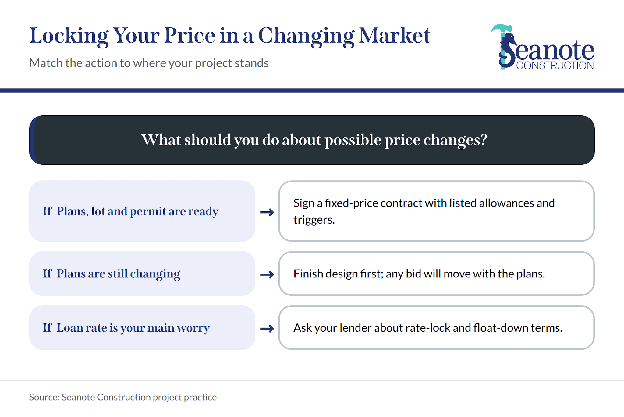
Figure 2: Your readiness, not a price guess, decides when to lock the contract. Source: Seanote Construction project practice.
Which Florida Laws Protect Your Money?
Florida protects your money through five checks rooted in Florida Statutes chapters 489 and 713. Each skipped check carries a dollar cost.
- License: look up the contractor on the DBPR site. A certified contractor works statewide, while a registered contractor works only where they hold local competency. Ours is CBC1264297, a Florida Certified Building Contractor license, and the risks of unlicensed contractors start with a lost deposit.
- Deposit: s. 489.126 sets deadlines for pulling the permit and starting work once a residential deposit tops 10%. A big deposit with no permit can become a lost deposit.
- Recovery fund notice: s. 489.1425 requires notice of the Florida Homeowners’ Construction Recovery Fund in the contract. A missing notice means the contract skipped a required term.
- Liens: under chapter 713, an unpaid subcontractor can lien your property even if you paid the contractor. Ask for lien releases with each draw, or you may pay twice.
- Draw schedule: tie each bank draw to a passed inspection. Draws released ahead of work pay for work not yet done.
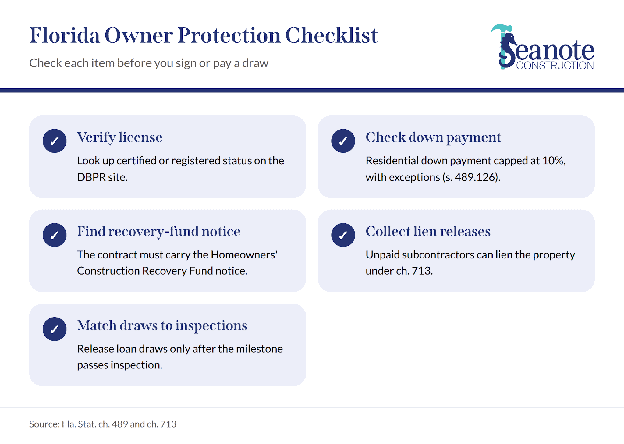
Figure 3: Five checks protect your deposit, your draws and your title. Source: Fla. Stat. ch. 489 and ch. 713.
Let’s Talk Through Your Florida Build
Turning a range into a real number takes patience. We walk through the budget line by line, in the order the work happens, as part of our custom home building process.
Seanote Construction holds Florida Certified Building Contractor license CBC1264297 and serves Gainesville and North Central Florida. You get regular updates through Final Walk Through and Adjustments and Closeout and Warranty Assurance.