
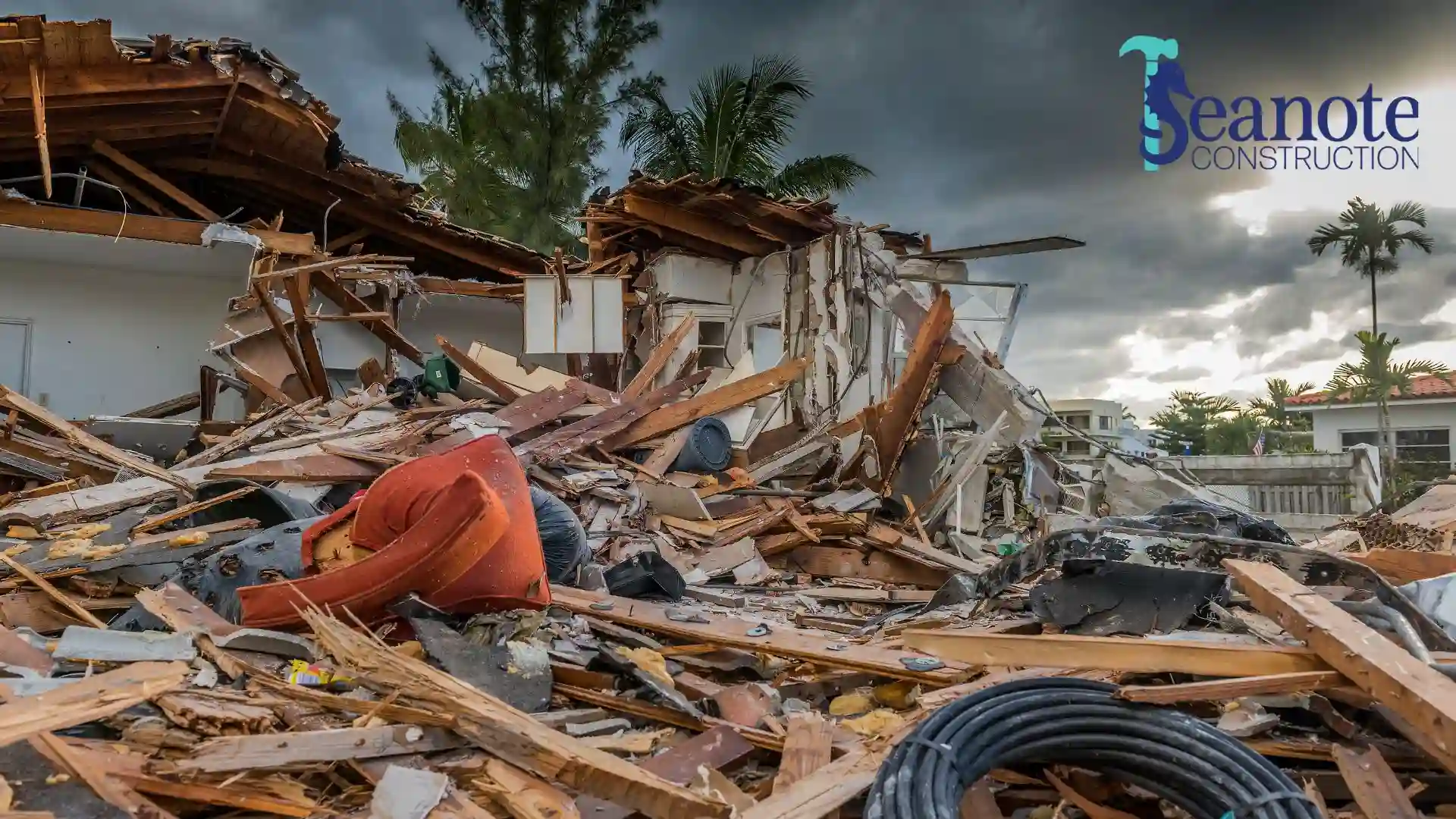
Living in Florida offers an unparalleled lifestyle, but it comes with the non-negotiable reality of severe weather. For homeowners in Gainesville, Ocala, and throughout Central Florida, the decision to build or renovate is about engineering peace of mind.
If you are currently evaluating construction partners or finalizing your architectural plans, you likely have a specific question in mind: How do I build a structure that protects both my family and my financial investment when the next major storm hits?
The answer lies beyond basic building codes. While local codes set a minimum standard for safety, true resilience requires a systems-based approach that integrates advanced engineering, superior materials, and a “continuous load path” philosophy.
At Seanote Construction, we transform structural research into actionable strategies, helping you handle the trade-offs between cost, durability, and design.
Understanding Why Code Minimums Can Fail
To understand why standard construction sometimes fails, we must first look at the physics of a hurricane. When a storm makes landfall, your home is subjected to three distinct forces:
- Wind Uplift: High winds moving over your roof create a vacuum effect, attempting to lift the roof structure off the walls.
- Lateral Load: Wind pressure pushes against the walls, testing their shear strength and connection to the foundation.
- Internal Pressure: If a window or door is breached by flying debris, wind rushes in. This dramatically increases internal pressure, which can blow the roof off from the inside out.
Building a “hurricane-proof” home is a misnomer. No structure is entirely immune to nature. However, building a climate-resilient home that withstands these forces with minimal damage is entirely achievable with the right strategy.
What is the Continuous Load Path?
The single most critical concept in resilient construction is the Continuous Load Path. Think of your home not as separate components (roof, walls, floor), but as a single, unified system.
A continuous load path effectively ties the house together from the top of the roof down to the foundation. It makes sure that when wind uplift pulls on the roof, the load is transferred to the walls, then down to the floor, and finally into the foundation and the ground.
Without this reinforced chain of connections, like using specific metal connectors, straps, and fasteners at every junction, the structural components act independently, making them far more susceptible to failure. At Seanote Construction, we view this engineering principle as the non-negotiable baseline for integrity in Florida building.
Handling the FORTIFIED Home™ Program
During your research, you may have encountered the FORTIFIED Home™ program by the Insurance Institute for Business & Home Safety (IBHS). This voluntary construction standard goes beyond code to strengthen homes against severe weather. Understanding these tiers helps you decide “how much” resilience you need.
FORTIFIED Roof™
This level focuses exclusively on the roof system. It requires:
- Stronger connections: Ring-shank nails (which have twice the holding power of smooth nails) installed in a tighter pattern.
- Sealed Roof Deck: A membrane or tape over the seams of the roof sheathing. If the shingles blow off, this secondary water barrier prevents water from pouring into your home.
- Locked-down edges: Enhanced metal drip edges to keep the wind from peeling up the roof covering.
FORTIFIED Silver™
This includes all Roof requirements plus protection for openings. It mandates impact-resistant windows, doors, and garage doors (or approved shutter systems) to prevent the internal pressurization mentioned earlier. It also strengthens the connection between the roof structure and the walls.
FORTIFIED Gold™
The highest level of protection. It includes all Silver requirements and adds a fully engineered continuous load path from the roof to the foundation. It addresses the structural integrity of the walls and how the house is anchored to the ground. For homeowners seeking maximum longevity and safety, this is the benchmark.
The Importance of Material Selection
Resilience starts with what you build with. The market is flooded with options, but three categories stand out for Florida’s climate.
Insulated Concrete Forms (ICFs) vs. Concrete Block
While traditional wood framing is common, masonry remains king in Florida for a reason.
- Concrete Block (CMU): The standard for Florida first floors. When properly reinforced with steel rebar and poured concrete cells, it offers immense resistance to wind-borne debris.
- Insulated Concrete Forms (ICFs): These are hollow foam blocks stacked and filled with reinforced concrete. They offer superior insulation (energy efficiency) and can withstand winds exceeding 200 mph. While the upfront cost is higher than standard block, the energy savings and protection provide a better ROI.
Impact-Resistant Windows and Doors
Your openings are the armor of your home. Impact windows are constructed with laminated glass, a layer of polyvinyl butyral (PVB) sandwiched between two panes of glass. If shattered by debris, the glass adheres to the interlayer rather than flying into the home, maintaining the building envelope’s seal.
Resilient Roofing Systems
The geometry of your roof matters as much as the material.
- Hip Roofs: A roof that slopes down on all four sides (hip roof) is significantly more aerodynamic than a gable roof (which has two flat ends). Hip roofs perform better under high wind loads because there is less surface area for the wind to “catch.”
- Materials: Metal roofing is widely considered the most durable option for storm resistance, often rated for winds up to 140+ mph. However, high-quality architectural shingles, when installed with the FORTIFIED method (starter strips and proper nailing), can also provide excellent protection.
The Financial Case for Resilience
A common hesitation among decision-makers is the upfront cost of resilient materials. However, when analyzed through a 10 or 20-year ownership window, resilient construction is often the more financially conservative choice.
- Insurance Savings: In Florida’s volatile insurance market, premiums are a major carrying cost. Homes built to FORTIFIED standards often qualify for significant discounts. The Florida Office of Insurance Regulation notes that mitigation credits can substantially offset the higher cost of premium materials.
- Damage Mitigation: Moody’s Analytics data suggests that for every $1 spent on hazard mitigation, the U.S. saves $6 in future disaster costs. For an individual homeowner, this means avoiding the catastrophic deductible payments and displacement costs that follow a major storm.
- Resale Value: As climate awareness grows, “storm-ready” features are becoming a premium selling point. Buyers are increasingly educated on the value of a new roof, impact windows, and solid construction.
If you are planning a ground-up build or looking to upgrade your current property through renovation services, investing in resilience protects your equity.
Retrofitting for Existing Homes
Not everyone is building from scratch. If you own an existing home in Ocala or Orlando, you can still improve its survivability profile. Prioritize these upgrades:
- Roof Replacement: When it’s time to re-roof, insist on a “sealed roof deck” with synthetic underlayment. This is the single most effective retrofit to prevent water damage.
- Brace the Garage Door: Garage doors are often the first failure point due to their large surface area. Installing a brace kit or replacing the door with a wind-rated model is a cost-effective upgrade.
- Window Protection: If replacing all windows with impact glass is outside the budget, approved polycarbonate shutters or steel panels offer excellent protection during a storm, even if they lack the passive convenience of impact glass.
Moving Forward with Confidence
Building in Florida requires a partner who values integrity as much as you value safety. It requires transparency about costs, a deep understanding of local wind-borne debris regions, and a commitment to not cutting corners on the things you can’t see.
At Seanote Construction, we believe that true craftsmanship is tested when the skies darken. If you are ready to discuss how to balance your design vision with uncompromised safety, we invite you to explore our approach to new construction. Let’s build a legacy that stands the test of time.