
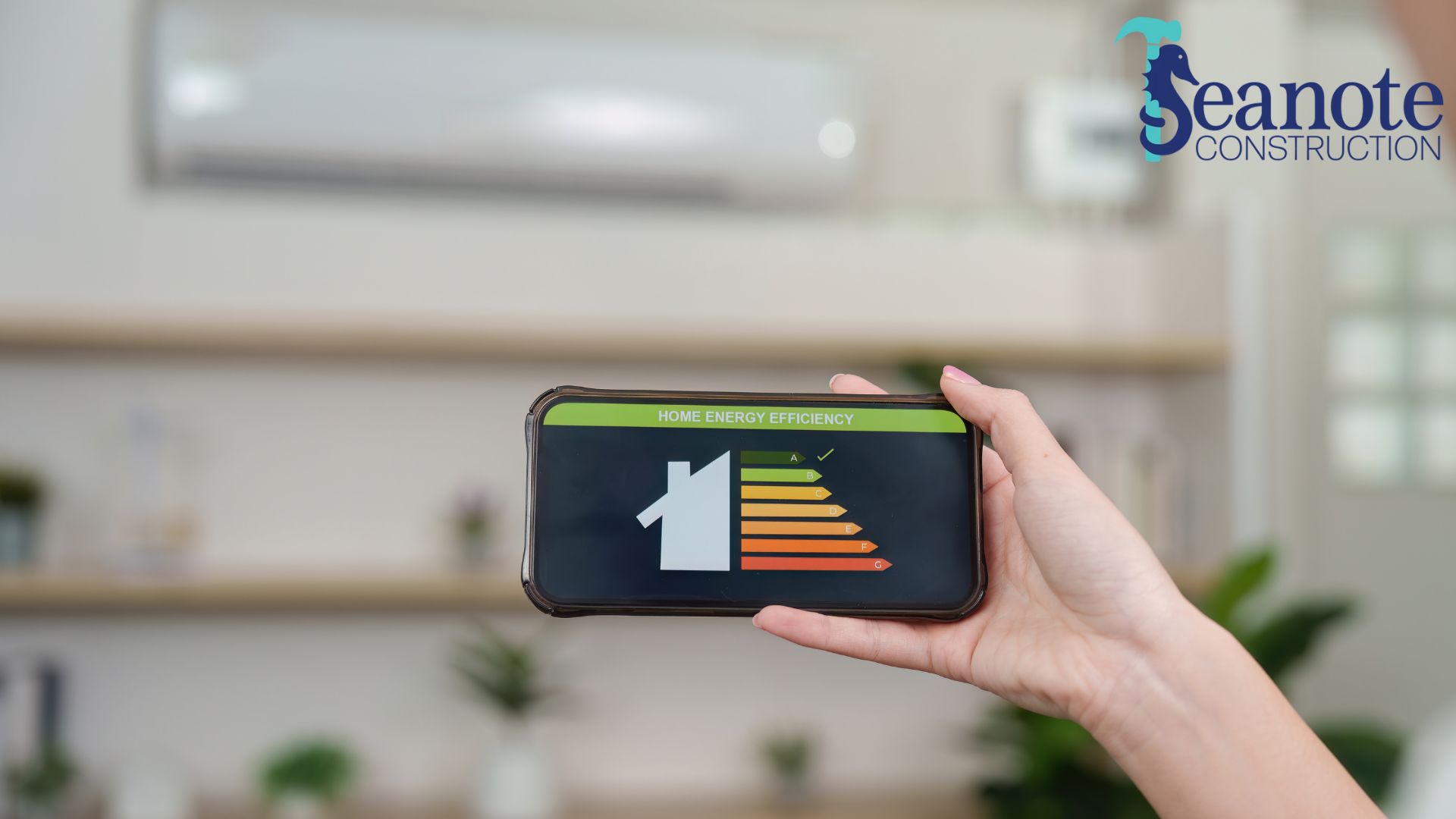
Living in Florida presents a unique challenge. We are constantly battling the elements to maintain comfort. For homeowners in Gainesville, Ocala, and Orlando, the challenge isn’t just about keeping the heat out, it’s about managing humidity, surviving hurricane season, and controlling skyrocketing utility costs.
According to the Energy Information Administration (EIA), the average Florida household consumes over 1,100 kWh of electricity per month, significantly higher than the national average. This is a monthly reminder that your home’s performance matters.
At Seanote Construction, we view your home as an integrated system. True energy efficiency isn’t achieved by slapping a solar panel on a leaky roof. It requires a holistic approach that combines structural integrity with advanced technology.
Key Takeaways
- In Florida, real efficiency starts with a tight, storm-resistant building envelope using the right wall system and insulation to stop heat and air leaks.
- Prioritize low-SHGC, impact-rated windows to cut solar heat gain while also improving hurricane protection and potential insurance savings.
- Size HVAC for humidity control (often with variable-speed or two-stage systems) so your home dehumidifies properly, stays comfortable, and avoids mold risk.
Understanding Your Home’s Envelope
The most critical decision you will make affects the part of the house you rarely see once the drywall is up: the shell, or “envelope.” In Florida, your walls must perform two distinct functions simultaneously. They must insulate against intense radiant heat and withstand wind loads from tropical storms.
If you are evaluating bids for a custom home or a major addition, you are likely comparing different construction methods. Here is how they stack up in our climate.
Concrete Block vs. ICF vs. Advanced Framing
Concrete Block (CBS)
This is the Florida standard for a reason. It is durable, familiar to all tradesmen, and meets code requirements effectively. However, concrete is highly conductive, meaning it absorbs heat all day and radiates it into your home at night.
To make CBS truly efficient, it requires rigid foam insulation on the exterior or injection foam in the cores, which are steps often skipped by volume builders.
Insulated Concrete Forms (ICF)
For clients prioritizing efficiency and safety, ICF is the gold standard. These are hollow foam blocks stacked like LEGOs and filled with steel-reinforced concrete. The result is a continuous layer of insulation (often R-22 or higher) that eliminates “thermal bridging.”
- The Advantage: ICF homes often require 30-40% less energy to cool than standard block homes.
- The Resilience Factor: They offer superior impact resistance against flying debris during hurricanes.
Advanced Wood Framing
While less common in South Florida, advanced framing (using 2×6 studs spaced further apart) allows for deeper cavity insulation. In Central Florida regions like Gainesville, this can be a cost-effective option for renovations, provided high-performance spray foam is used to seal the envelope completely.
The Verdict on Insulation
Regardless of the structural method, the insulation material is the game-changer.
- Open-Cell Spray Foam: Expands to fill every crack and crevice. It’s excellent for sealing the underside of roof decks, moving your attic into the “conditioned space.” This prevents your HVAC ducts from sweating in a 130-degree attic.
- Rigid Foam Board: Essential for retrofitting existing block walls during a remodel to stop heat transfer before it reaches your drywall.
Understanding Efficiency With Windows
In Florida, windows are traditionally the weakest link in the energy chain. When evaluating window packages, you are looking for two specific metrics that appear on the NFRC label.
1. Solar Heat Gain Coefficient (SHGC)
This measures how much solar radiation passes through the glass. In our climate, lower is better. We recommend a verified SHGC of roughly 0.25 or lower. This blocks the invisible heat that fades your furniture and forces your AC to work overtime.
2. Impact Rating
This is where ROI becomes interesting. Impact-resistant windows (often called “hurricane windows”) feature laminated glass that holds together if shattered.
- Energy Benefit: The lamination process combined with Low-E coatings creates a significant thermal barrier.
- Financial Benefit: Beyond lowering electric bills, impact windows are a primary factor in wind mitigation inspections, which can drastically reduce your homeowner’s insurance premiums, a critical consideration given Florida’s insurance market.
Mastering HVAC in a Humid State
You cannot talk about Florida building without addressing humidity. A common mistake we see in client consultations is the desire for “the biggest AC unit possible.” This is actually counterproductive.
If an AC unit is oversized, it cools the room too quickly and shuts off before it has removed the moisture from the air. This leads to a cold, clammy house and potential mold issues.
We guide clients toward Variable Speed or Two-Stage systems. Unlike traditional units that run at 100% or 0%, these systems can ramp down to run at lower speeds for longer periods.
This continuous low-level operation is highly efficient and acts as a whole-home dehumidifier, improving Indoor Air Quality (IAQ) and comfort at higher thermostat settings.
Solar Integration and ROI
With the “Sunshine State” nickname, solar seems obvious. However, the math must make sense.
- Solar-Ready Design: Even if you don’t install panels immediately, we design roof trusses to support the future load and run conduit from the attic to the electrical panel during the rough-in phase. This saves thousands on future installation costs.
- Battery Storage: With the frequency of summer storms, battery backup systems are becoming as popular as generators, offering silent, seamless power during outages.
Code Compliance vs. Performance
The 8th Edition (2023) Florida Building Code introduced stricter requirements for thermal envelopes and air leakage. Many builders view code as a target to hit. We view it as the minimum legal baseline.
For example, while code may dictate a specific R-value for ceiling insulation, it doesn’t account for the quality of the installation. A rushed installation with gaps performs significantly worse than a lower R-value installed with precision.
Our background and experience drives our construction philosophy. Precision and attention to detail are what actually deliver the savings promised on paper.
Your Next Step With Seanote Construction
Building or renovating in Florida is a significant financial commitment. You deserve a property that protects your family and your wallet. By prioritizing the building envelope and optimizing your HVAC for humidity, you move beyond standard construction into the realm of high-performance living.
If you are looking to build a custom home in Ocala or remodel a kitchen in Gainesville, Seanote Construction brings the rigorous attention to detail required to execute these systems correctly.
Ready to evaluate your options? Let’s discuss how we can maximize the efficiency and value of your project.